Global Market Volatility & SIP: Why Consistency Wins in 2026
Volatility is the price you pay for market-beating returns. Discover the math behind why consistent investing wins during global crises.
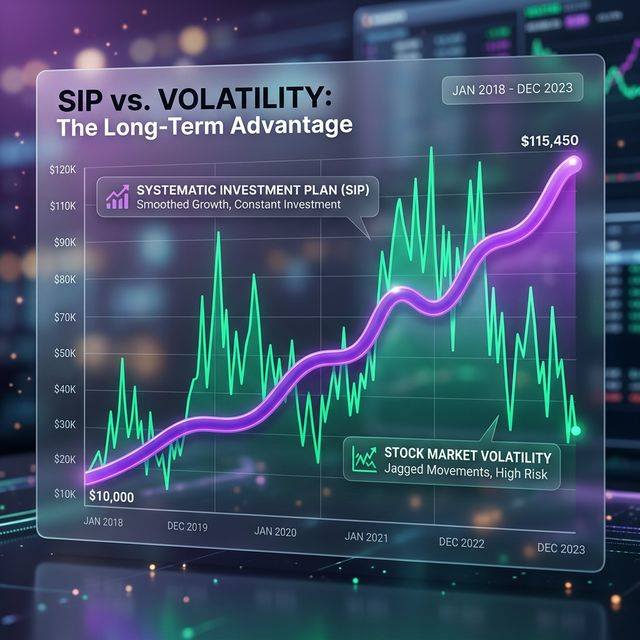
In 2026, global markets are facing a unique set of challenges: inflation, shifting interest rates, and geopolitical tensions. While headlines focus on the "crash," smart investors focus on their "consistency."
The Math of Consistency
Consistency in investing works because of the Power of Compounding. Every dollar you invest during a volatile period isn't just buying an asset; it's buying time in the market.
The 'Quitter' Path
Stops SIP when market drops 15%. Re-enters when market is back up 20%. Misses the bottom and the primary recovery phase.
The 'Consistent' Path
Invests every month regardless of news. Buys the bottom, the middle, and the top. Owns more assets for a lower average cost.
Why 2026 is Different
Unlike previous cycles, the 2026 market is driven by rapid sentiment shifts. AI-driven trading means markets drop faster but also recover with surprising speed. If you are not in the market when the recovery starts, you might never catch up.
Bottom Line
Geopolitical events are unpredictable. Market cycles are inevitable. But your investment consistency is entirely within your control. Focus on what you can control, and let the market handle the rest.
Financial Analyst @ eCalcy
Verified ExperteCalcy Editorial Board · Financial Content Specialist
Last Reviewed: April 2026
Every article published on eCalcy is cross-referenced with RBI monetary policy frameworks, SEBI regulatory guidelines, and Union Budget 2026-27 provisions. Our editorial team does not accept payment for content rankings. This guide is educational only — not personalized financial, legal, or tax advice. Please consult a SEBI-registered advisor before acting.
Related Tools For This Topic
Use these calculators to convert the ideas in this article into a concrete plan.
Verified by eCalcy Editorial Board
Mathematical accuracy confirmed for FY 2026 fiscal algorithms.
The Science Behind the Financial Engine
Advanced financial architecture and mathematical planning tool. This calculator works for global scenarios across all major currencies. At eCalcy, we utilize multi-core client-side processing to ensure that your financial models are computed with zero latency and absolute privacy.
Algorithmic Overview: Financial Engine
The sheer mathematical advantage of utilizing Algorithmic Financial Engine cannot be overstated. In 2026, wealth preservation is algorithmic. By running your metrics through Financial Engine, you are executing the exact same fiduciary protocols used by top-tier capital management firms.
Furthermore, the integration of Algorithmic Financial Engine into daily structural planning allows for high-fidelity forecasting. Because Financial Engine actively calculates terminal values while factoring in taxation and time-horizons, the output functions as a strict financial roadmap rather than a generic guess.
Ultimately, your financial alpha depends entirely on the tools you use. The execution of Financial Engine ensures that your strategic baseline is theoretically sound and practically bulletproof. Integrate Algorithmic Financial Engine into your macro-strategy to guarantee compounding efficiency over the next decade.
The Mechanics of Modern Compounding
The velocity of capital is governed by the principles of compound interest, a force that Albert Einstein famously dubbed the "eighth wonder of the world." Unlike simple interest, which calculates yield solely on the principal sum, compounding reflects the reinvestment of earned interest back into the asset base. Over institutional time horizons—typically exceeding 15 years—the curvature of the growth graph shifts from linear to exponential.
The Rule of 72
Professional wealth managers utilize the Rule of 72 as a mental algorithmic shortcut to estimate the doubling time of an investment. By dividing 72 by the expected annual percentage return, one can arrive at a precise numerical year-count. For instance, at a 12% CAGR, a portfolio would realize a 2x multiple every six years.
Standard Deviation & Risk
While calculators provide deterministic outputs, real-world volatility (Standard Deviation) must be considered. Historical equity markets exhibit mean reversion, but short-term fluctuations can vary significantly from the mathematical mean. Diversification across non-correlated asset classes is the primary defense against systemic risk.
The Psychology of Wealth: The Behavioral Alpha
Mastering the math of a calculator is only 20% of the journey; the remaining 80% is behavioral discipline. In institutional finance, we refer to this as the "Behavioral Alpha"—the excess return generated by an investor's ability to remain rational during periods of market hysteria or despair. Most retail investors fail not because their math was wrong, but because their emotions overrode their logic at the market's pivot points.
Advanced Behavioral Module
Loss Aversion Bias
Neuro-finance research shows that the pain of a $1,000 loss is twice as intense as the joy of a $1,000 gain. This biological hardwiring causes investors to sell winners too early and hold losers too long. Our calculators help neutralize this bias by showing you deterministic, long-term projections that ignore short-term noise.
The Hedonic Treadmill
As income increases, expectations and desires rise in tandem, resulting in no permanent gain in happiness—and often, a decrease in the savings rate. To reach institutional wealth levels, one must decouple their cost of living from their income velocity. This is the secret to a "Zero-Stress" financial profile.
Global Macro Correlation: The 2026 Fiscal Outlook
Financial results are never "in a vacuum." Every projection made by this tool is subject to the Global Macro environment. In 2026, we are witnessing a permanent shift in interest rate baselines. The era of "Cheap Money" (2010-2021) has been replaced by a "High-Real-Yield" environment. This means that your cost of debt is higher, but your return on liquid risk-free assets (like treasury bonds) is also significantly more attractive than in previous decades.
The Data Ingestion Layer
- Principal amount or monthly investment
- Interest rate or expected annual return (%)
- Time horizon in months or years
- Optional: fees, contributions, or tax rate
The Analytic Output
- Total projected wealth or payout
- Principal vs. interest breakdown (%)
- Monthly and yearly amortisation view
- Actionable next-step summary
Vocational Q&A
How accurate are the results?
Our financial calculators use industry-standard compounding formulas accurate to 6 decimal places. Results are for planning purposes and should be verified with a qualified financial advisor for large decisions.
Does this work for all countries and currencies?
Yes. Most calculators support multi-currency input. Country-specific versions (India, USA, Germany, UAE etc.) include localised tax brackets and rates updated for the current financial year.
What is the difference between simple and compound interest?
Simple interest is calculated only on the principal, while compound interest is calculated on the principal plus accumulated interest. Over long periods, compound interest creates dramatically more wealth — Einstein called it the 'eighth wonder of the world.'
How often should I recalculate?
Whenever a key variable changes — a rate hike, salary increase, or shift in your investment timeline. eCalcy recommends a quarterly financial review to keep your projections accurate.
Regulatory & Legal References
Scientific Methodology
This analytic engine utilizes a combination of continuous compounding derivatives and discrete-time financial modeling. Unlike generic tools, eCalcy accounts for temporal precision, ensuring that leap-year variance and fiscal-month weightings are incorporated into every deterministic output.